
Pickleball strategy guide
The doubles strategy that wins close games
Positioning, the third shot, dinking patience, stacking, and shot selection — the tactics that decide tight rec doubles, explained simply.
Strategy beats power
At the rec level, clean technique only takes you so far. Games are won by getting to the right place, choosing the right shot, and not giving away the attackable ball. These are the doubles fundamentals that move the needle fastest.
Four habits that win doubles
Win the race to the kitchen
Most doubles points are decided by which team controls the non-volley line. After your return or third shot, move up together and earn the line — the team that gets there first dictates the rally.
Pick: third shot drop or drive
Drop when you have time and a clean ball, aiming a soft arc into the kitchen so you can advance. Drive when the return sits up or your opponents crowd the line — then follow it in and look for the fifth-shot drop.
Dink with patience
At the kitchen, the goal is not to win every dink — it is to avoid giving away the ball that gets attacked. Keep dinks low and unattackable, move opponents side to side, and wait for the pop-up before you speed it up.
Move as a unit
Partners shift left, right, up, and back together as if connected by a rope. Cover the middle, close the gaps, and never leave one player up while the other is stuck back.
Third shot drop vs. drive
Both shots have a place. Here is when each one is the right call after the return.
| Third shot drop | Third shot drive | |
|---|---|---|
| Best when | Return is deep or low | Return floats high or short |
| Goal | Reset, then advance | Force a weak reply |
| Risk | Too high → gets attacked | Too flat → goes out or back |
| Follow-up | Move to the line | Drive then drop the fifth |
| Pace | Soft and arced | Firm and flat |
From knowing to doing
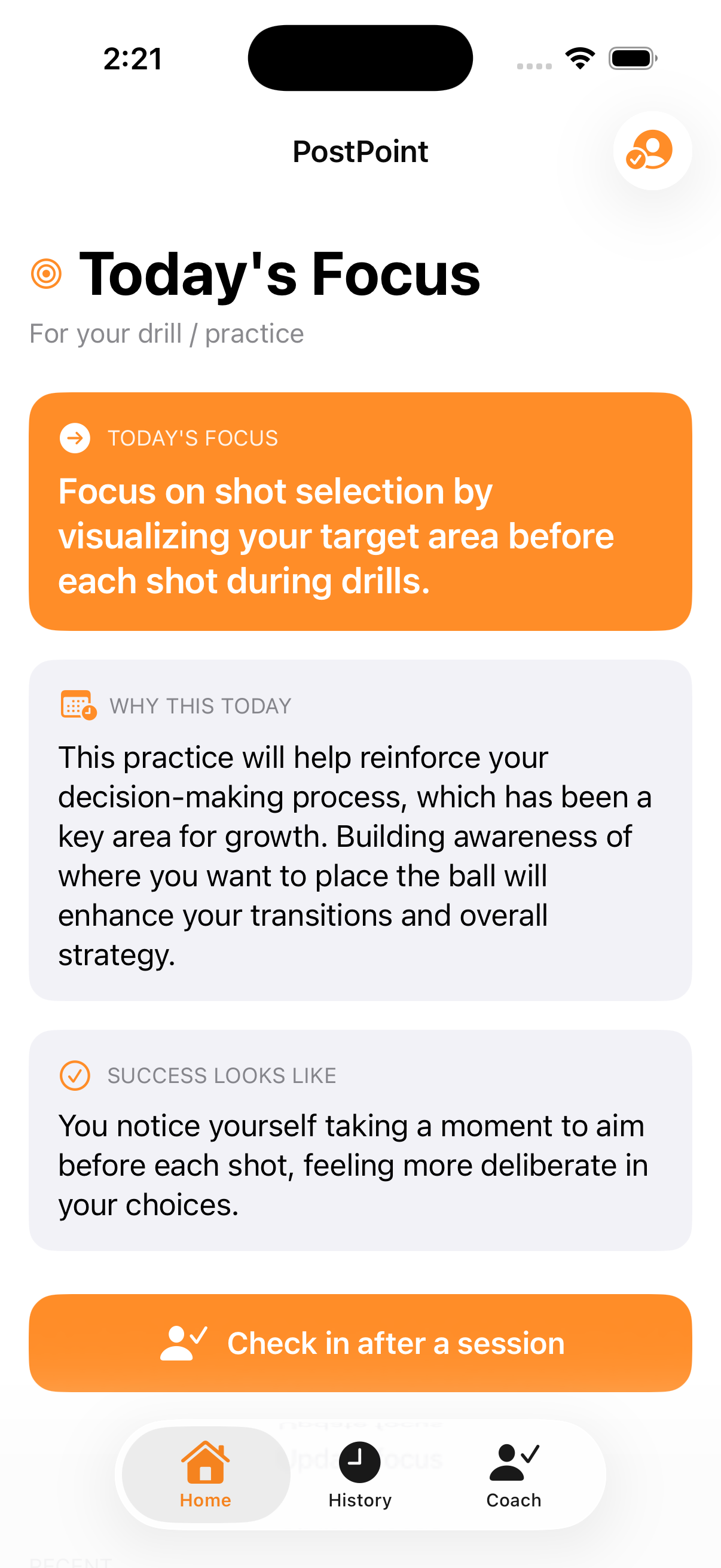
Knowing the tactics is one thing — making them hold up under pressure is another. PostPoint is the coach that bridges the gap: before you play it gives you a few things to focus on, like keeping your first dinks crosscourt; after a 20-second check-in it tells you the one thing to work on next. Strategy turns into a habit, one session at a time.
Frequently asked questions
- When should I drive the third shot instead of dropping it?
- Drive when the return floats high or lands short and you can take it on the rise, or when your opponents are hugging the kitchen line and a hard ball at their feet or hip is uncomfortable. Drop when the ball is low, deep, or you simply need time to get to the line. Many players drive then drop the fifth — the drive forces a weak reply you can convert into a soft ball.
- What is stacking and why do it?
- Stacking is lining up so your players stay on their stronger sides regardless of the score — for example keeping a right-handed forehand and a left-handed forehand both in the middle. You start on the same side of the court and one player slides across after the serve or return. It is a positioning tool, not a rule change, and it can be worth it when a partner is much stronger on one wing.
- How should partners communicate during a point?
- Keep it short and early. Call "mine" or "yours" on balls down the middle before they arrive, "bounce it" or "no" on balls drifting out, and "switch" when you cross to cover a lob or a poach. Talk between points too — agree on who takes the middle and which opponent you are targeting.
- Is it really smart to target the weaker opponent?
- Yes, and it is standard doubles strategy, not poor sportsmanship. Hitting the majority of your balls at the weaker player or the weaker wing (often the backhand) raises your odds of drawing an error or a pop-up. Mix in the occasional ball to the stronger player so they do not stay fresh, but keep the pressure where it works.
Keep exploring
Pickleball Coaching App
What PostPoint is, how the check-in loop works, and how it compares to lessons and YouTube.
Pickleball Training App
A coach, not a training-plan generator — how the focus-and-check-in loop trains your game.
Pickleball Drills App
Why PostPoint isn’t a drill library — it tells you the one thing to focus on next.
DUPR Rating Explained
What DUPR measures, how it differs from the 2.5–5.0 levels, and how to actually raise it.
Best Pickleball Apps
An honest 2026 overview of pickleball apps for coaching, drills, rating, and finding games.
Your next session starts with a focus
PostPoint is on iOS, free to start, and works without an account. Set your first focus, play, and check in after — your coach takes it from there.